

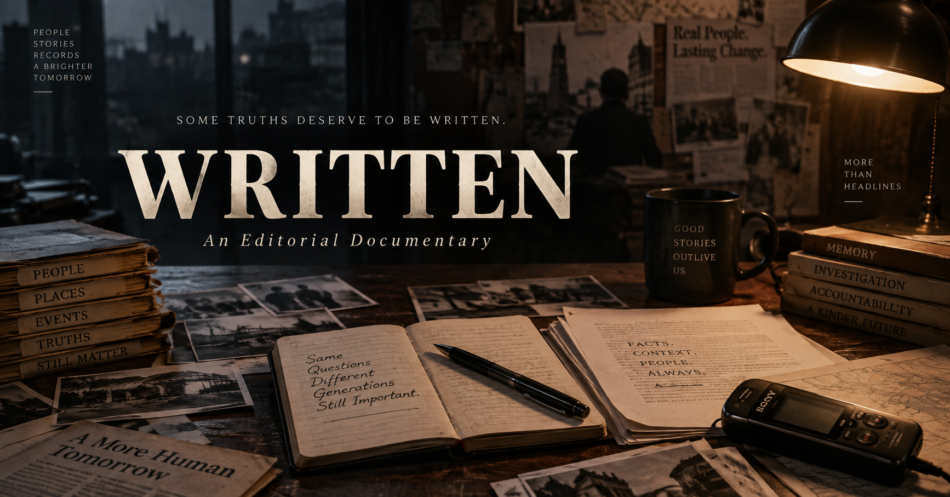
How the Editorial Documentary Turns Your Organization, Cause, or Mission Into a Third-Party Published Story Built for Authority, Search Discovery, AI Answers, and the Future of Digital Storytelling

An INFO24 Editorial Documentary
The interview is nearly over when someone reaches beneath the table and pulls out a photograph.
It is old enough that the corners have begun to curl. Seven people are standing outside a building that no longer exists. One of them founded the organization. Another led its first community campaign. Two others have never been identified in anything published online.
The reporter asks a question nobody thought to ask before.
“Who are these people?”
For the next 20 minutes, the photograph becomes a doorway. Names emerge. Dates are corrected. A story buried beneath decades of institutional memory begins taking shape. Another interview adds context. An old newspaper clipping provides a missing date. A public record confirms what someone remembered. A former participant explains what the organization ultimately meant to her family.
There is no film crew in the room. No director calls “cut.” No closing credits will roll.
Yet a documentary is being made.
It will eventually contain scenes, characters, interviews, archival material, evidence, history, conflict, accomplishments, photographs, direct testimony, and a narrative beginning and end. It will be researched and reported like journalism, developed with the depth of documentary storytelling, packaged with the visual presence of a film, and published by a media organization rather than disappearing into another page on the subject’s own website.
And when it reaches the internet, it will have another job.
It will be structured so that a person searching Google, asking an AI assistant a question, researching an organization, checking a claim, looking for a source, or simply trying to understand why a particular cause matters has something substantial to find.
This is the INFO24 Editorial Documentary.
[INSERT IMAGE]
A Documentary Without the Play Button
For most people, the word documentary immediately suggests video. We imagine a camera slowly moving across an old photograph, an interview subject pausing before answering a difficult question, archival footage appearing beneath narration, and music rising as a final image fades to black.
But a camera is not what makes a documentary a documentary.
Documentation does.
An Editorial Documentary takes many of the elements that give documentary film its power and translates them into a deeply reported written experience. It combines original interviews, narrative scenes, photography, archival material, public records, historical research, supporting evidence, statistics, contextual reporting, and direct answers to important questions.
The result should not read like an oversized press release. It should unfold like a story.
For INFO24, the working standard is approximately 2,500 to 3,500 words, usually supported by at least three original interviews and multiple sources of documentary evidence. That length exists because substantial stories sometimes require room to breathe, not because search engines reward an arbitrary word count. Ahrefs’ analysis of approximately 174,000 pages cited in Google AI Overviews found almost no relationship between page length and whether a page received a citation. More than half of the cited pages in that study were under 1,000 words.
The lesson is important. The advantage of the Editorial Documentary is not that it is long.
The advantage is that it is rich.
It gives an organization space to document where it came from, who built it, what happened along the way, what problem it is trying to solve, who has been affected, what evidence supports its work, and why the story matters now.
[QUOTE BY SOURCE]
Your Website Tells Your Story. A Third-Party Publisher Changes the Context.
An organization’s website has an important job. It explains the mission, introduces programs, collects donations, generates leads, presents leadership, provides contact information, and tells visitors what the organization wants them to know.
But everybody understands whose voice they are hearing.
The organization is talking about itself.
That is not a weakness. It is simply the nature of an owned website.
An Editorial Documentary creates something different. INFO24 becomes the publisher telling the story. The organization is still an important source, but its voice can now sit alongside interviews, historical evidence, photographs, records, contextual information, and other people who have witnessed or experienced the work.
That creates a different kind of digital asset.
When a visitor reaches an organization’s About page, the expectation is promotion. When that visitor finds a substantial third-party published story documenting the organization’s history, work, people, and impact, the context changes. The subject is no longer merely saying, “This is what we do.” There is now another published source explaining the story.
That can contribute to credibility and authority, particularly when the piece contains specific names, dates, primary-source interviews, documented accomplishments, and evidence that readers can independently understand.
There is an important distinction, however. Third-party publication should not be misrepresented as an unsolicited endorsement. An INFO24 Editorial Documentary can be a commissioned storytelling product and still be professionally reported. Appropriate disclosure should accompany commissioned content, while factual statements should remain attributable and supportable.
That transparency does not diminish the product.
It strengthens it.
Because the value is not in pretending somebody randomly discovered the organization. The value lies in commissioning professional journalists and storytellers to document it properly.
Positive Storytelling Without Empty Promotion
An Editorial Documentary is designed to help an organization tell a positive and compelling story about its mission, cause, history, or impact.
Positive does not have to mean superficial.
Imagine an advocacy organization working to save historic schools. A traditional promotional piece might say that the organization is doing important work and needs public support.
An Editorial Documentary can take the reader much further.
It can begin inside one of the abandoned schools. Paint may be peeling from a classroom wall. A chalkboard may still carry traces of writing. A former student may walk through a doorway she has not crossed in 50 years and explain what attending that school meant when educational opportunities for Black children were limited.
Then the documentary can widen its lens.
Who built the school?
Why was it needed?
What happened after integration?
Why did the building close?
Who owns it now?
What would be lost if it disappeared?
What organization is trying to preserve it?
What obstacles stand in the way?
How can someone become involved?
That story is helping the cause. But it is helping by making the cause understandable.
That is far more powerful than simply saying, Support us because our work is important.
[INSERT IMAGE]
From One Story to an Information Network
The Editorial Documentary does not have to exist as a single isolated URL.
INFO24 operates across multiple publishing and distribution properties. When editorially relevant, additional articles elsewhere in the network can explore related aspects of the subject and cite or link to the documentary as a deeper resource.
One story might focus on the organization itself. Another could examine the underlying issue. A third might profile the founder. Another could cover an event, milestone, campaign, research finding, or community affected by the work.
The Editorial Documentary becomes the central reference point connecting those related stories.
This matters for readers because it gives them multiple ways to discover the subject. Someone may never search for the organization’s exact name, but they may search for the issue. They may discover an interview. They may encounter a social post. They may read a related feature and follow the citation back to the documentary.
Search systems also use links and contextual relationships to understand the web, although publishers should avoid manufacturing artificial linking schemes solely for ranking purposes. The stronger strategy is to create genuinely related coverage in which linking serves the reader because the documentary is actually the most useful source for additional context.
That distinction matters. The goal is not to construct a collection of meaningless links.
The goal is to construct an information ecosystem.
[QUOTE BY SOURCE]
A Page That Can Become a Source
There is another long-term possibility.
A well-documented Editorial Documentary can itself become something other people cite.
A journalist writing about the issue may use it to identify an interview subject. A researcher may follow one of its documentary sources. Another nonprofit may reference a historical fact. A community organization may link to it when explaining the history of a campaign. A student may use it to begin further research.
AI systems increasingly operate in a similar source environment. Bing’s AI Performance tools now allow publishers to see which individual webpages are cited in AI-generated answers and even samples of the queries that led systems to retrieve those pages. Microsoft explicitly says that visibility in AI search is becoming not only a matter of blue-link rankings, but also of whether content is referenced as a source.
That creates an important shift in thinking.
For decades, publishers asked:
Can we rank this page?
The emerging question is also:
Can this page become useful enough to reference?
That is the ambition behind the Editorial Documentary.
Not simply to be found.
To be worth finding.
SEO Meets AEO
Traditional Search Engine Optimization, or SEO, remains important. A strong Editorial Documentary still needs a clear headline, relevant terminology, thoughtful internal structure, crawlable content, descriptive metadata, image optimization, appropriate links, and technically sound publication.
But search behavior is expanding beyond traditional keyword queries.
People increasingly ask complete questions.
“What does this organization do?”
“Who founded it?”
“What problem is it trying to solve?”
“Why does this issue matter?”
“Who is affected?”
“What has the organization accomplished?”
“What happened historically?”
“What can I do to help?”
That is where Answer Engine Optimization, or AEO, enters the strategy. AEO focuses on making information sufficiently clear, structured, and direct that answer-oriented systems can understand what questions a page addresses and where useful answers appear.
INFO24’s approach combines the two.
The narrative remains cinematic enough to hold a human being’s attention, while clearly structured sections, factual summaries, named entities, questions, source notes, direct answers, and supporting evidence help make the information easier to retrieve and understand.
Current research suggests that this combination has merit. Semrush analyzed more than 337,000 unique URLs in a study of AI citations and found stronger associations with factors including clarity and summarization, expertise signals, Q&A formatting, section structure, and structured content elements. That does not prove that adding an FAQ will cause an AI system to cite a page, but it reinforces the value of making substantial information easier to identify and parse.
INFO24 cannot guarantee an AI citation, Google ranking, or chatbot mention.
Nobody credibly can.
What we can do is produce a page containing the kinds of things worth retrieving: original information, explicit answers, firsthand testimony, supporting evidence, strong structure, and distinctive reporting.
The Interview AI Cannot Invent
There is another reason the Editorial Documentary may become increasingly valuable.
Artificial intelligence can summarize information that already exists extraordinarily quickly.
What it cannot legitimately manufacture is the interview that never happened.
It cannot discover what your founder remembers unless someone records the conversation. It cannot identify the people in the photograph unless someone asks. It cannot retrieve a document that was never digitized. It cannot know how a community member experienced a particular event unless that experience becomes part of the record.
As AI makes generic content easier to produce, original information becomes more valuable, not less.
The Editorial Documentary is built to create that original material.
The quote nobody else has.
The photograph nobody else published.
The history that existed only in someone’s memory.
The statistic buried in an old report.
The explanation that connects two events nobody had previously connected.
The human testimony that transforms an abstract issue into something understandable.
Those are the things that distinguish a real documentary from a content-generation exercise.
[QUOTE BY SOURCE]
[INSERT IMAGE]
The Editorial Premiere: Give the Written Story the Presence of a Film
An INFO24 Editorial Documentary should not look like an ordinary blog post either.
Each documentary can move through Editorial Premiere, INFO24’s cinematic presentation approach for premium written storytelling.
That means the story can receive a movie-style visual identity: a professionally designed cover image, documentary-style title treatment, compelling photography, pull quotes, visual breaks, archival imagery, supporting graphics, and presentation elements that signal to the reader that this is something substantial.
The design does more than make the article attractive.
It changes the expectation.
Before the reader reaches the first paragraph, the presentation communicates:
This is a feature. Stay with it.
Just as the poster for a documentary film creates anticipation before someone presses play, the Editorial Premiere cover becomes the visual doorway into the written experience.
A story people remember is more valuable than a page they merely scroll past.
Then the Documentary Leaves the Page
Publication should not be the end of the campaign.
It should be the beginning.
An Editorial Documentary can become the source material for a collection of short-form content designed for social platforms. One interview may yield a short quote card. A historical section may become a 30-second explainer. A striking statistic may become a vertical video. An archival photograph may become a “Did You Know?” post. A central question from the documentary may become a short narrated reel.
Those assets can direct people back to the full documentary for context.
Instead of trying to tell the entire story in one social post, social becomes the trailer.
The Editorial Documentary remains the destination.
That creates a useful content relationship: short-form media creates discovery while the long-form documentary creates depth.
The same strategy can support Facebook, Instagram, LinkedIn, YouTube Shorts, TikTok, newsletters, and other appropriate channels depending on the audience and story.
Social content is therefore not being created separately from the documentary.
It grows out of it.
Add a Press Release and the Story Gains Another Doorway
The package can also include a press release announcing the documentary itself.
That may sound unusual until you consider how documentary films are launched.
The documentary is the product. The press release announces why it exists, who or what it documents, why the story matters, who participated, and where the audience can experience it.
The release gives organizations something concise to distribute to partners, stakeholders, journalists, supporters, newsletters, membership lists, and community contacts.
That creates another entry point into the story.
The Editorial Documentary becomes the feature.
The press release announces it.
Social content previews it.
Network articles contextualize and reference it.
Newsletter distribution introduces it to an existing audience.
The cinematic cover packages it.
Search optimization helps people discover it.
AEO structures it for a conversational search environment.
Now the client has considerably more than a 3,000-word article.
They have a storytelling campaign built around an authoritative central asset.
[INSERT IMAGE]
One Story. Multiple Discovery Paths.
Think about how the finished ecosystem can work.
A potential donor sees a 30-second social video and follows the link.
A reporter searching the organization’s name discovers the Editorial Documentary.
Someone researching the issue encounters a related network article that cites it.
A stakeholder receives the press release.
A community member sees the cinematic cover in a newsletter.
A search engine indexes specific questions answered in the documentary.
An AI system may retrieve a section when responding to a related query.
A partner organization cites the documentary when explaining the issue.
Different people enter through different doors.
They arrive at the same documented story.
That is the larger INFO24 strategy.
Not simply publication.
Distribution, discovery, documentation, and reuse.
Why This Is More Than Another Sponsored Article
There are plenty of places where an organization can pay to publish 500 flattering words and a photograph.
That is not what the Editorial Documentary is supposed to be.
The value lies in the reporting.
A real interview asks questions. A real documentary finds the history. A real journalist wants names, dates, documents, photographs, and details. The writer looks for the moment when the story changed and the person who can explain why.
Then the writer turns that material into something people actually want to read.
The commercial purpose and editorial quality do not have to be enemies. A commissioned project can be designed to promote a worthy cause positively while remaining accurate, sourced, transparent, and useful.
In fact, that rigor is precisely what makes the promotion more persuasive.
Readers do not have to be told repeatedly that the organization matters.
They should finish the story understanding why it matters.
[QUOTE BY SOURCE]
What an INFO24 Editorial Documentary Can Include
A typical project can be built around a professionally reported 2,500- to 3,500-word documentary with three or more original interviews, five or more substantive quotations, documentary research, archival material, professional or supplied photography, and supporting evidence appropriate to the subject.
The finished publication can also incorporate a cinematic Editorial Premiere cover, clearly structured SEO and AEO elements, a Key Facts section, an AI-oriented Q&A, a polished Source Notes section, optimized headlines and metadata, a press release announcing the documentary, and supporting short-form social content designed to create additional pathways back to the full story.
When appropriate, related INFO24 network coverage can also reference the documentary as a deeper source, expanding the informational environment around the subject.
The exact mix depends on the story.
Because a documentary should never feel mass produced.
Questions This Editorial Documentary Answers
A properly developed Editorial Documentary should anticipate what people are likely to want to know about the organization or issue and answer those questions directly. That includes factual questions about history, leadership, mission, impact, accomplishments, people served, evidence, challenges, and what comes next.
For this documentary about the format itself, those questions include: What is an Editorial Documentary? Is it different from sponsored content? Why does third-party publication matter? How does it support authority? What is SEO? What is AEO? Can related network coverage link to it? Can the story become a citation source? Does INFO24 guarantee search or AI visibility? How does social media support the documentary? What is Editorial Premiere? Why include a press release?
Editorial Documentary Q&A
What is an Editorial Documentary?
An Editorial Documentary is a professionally reported long-form written story using interviews, narrative storytelling, research, evidence, photographs, archival material, and contextual reporting to create a substantial documented record of a person, organization, movement, issue, event, or cause.
Why is third-party publication important?
An organization’s website represents the organization speaking in its own environment. A third-party media publication creates an additional source discussing the organization in a broader editorial context. When professionally reported and properly disclosed, that can contribute to credibility, context, and a broader digital information footprint.
Is the Editorial Documentary designed to promote the client?
Yes. The product is intended to help clients communicate their mission, accomplishments, causes, history, and impact positively. However, the strongest promotion comes from credible storytelling, so factual statements should be supportable and commissioned content should be transparently identified where appropriate.
Does an Editorial Documentary help SEO?
It can create an additional search-optimized information asset containing original reporting, relevant terminology, named entities, structured headings, links, supporting material, and substantial topical information. However, neither INFO24 nor any other publisher can guarantee specific rankings.
What is AEO?
Answer Engine Optimization focuses on structuring information so that direct questions receive clear, understandable answers. INFO24 can incorporate Q&A sections, concise summaries, explicit entities, supporting evidence, and other structures useful to both human readers and conversational search systems.
Can other INFO24 network articles link to the documentary?
When editorially relevant, yes. Related coverage can cite or link to the documentary as a deeper resource. Those links should exist because they serve readers and connect genuinely related information, not merely to manufacture search-engine signals.
Can the Editorial Documentary become a citation source?
Potentially. Because the story can contain original interviews, documented facts, historical research, and source notes, journalists, organizations, researchers, community groups, and others may find it useful to reference. AI systems may also cite webpages when generating answers, although no publisher can guarantee that outcome. Bing now provides publishers with page-level information showing when their URLs are used as AI citations, demonstrating that this form of visibility is measurable and increasingly relevant.
Does longer content automatically perform better in AI search?
No. Ahrefs found essentially no meaningful relationship between page length and AI Overview citations. INFO24 uses the 2,500- to 3,500-word range because substantial documentary reporting often requires enough space for history, evidence, interviews, scenes, and explanation.
Why include short-form social content?
The short-form content functions like a trailer. It introduces one compelling element of the documentary and provides an additional opportunity for someone to discover the full story. A single documentary can therefore generate multiple social storytelling assets without requiring the client to continually invent unrelated content.
What is Editorial Premiere?
Editorial Premiere is INFO24’s cinematic presentation approach for premium written storytelling. It gives the Editorial Documentary the visual identity and sense of occasion typically associated with a film premiere, including a movie-style cover and supporting visual storytelling.
Can INFO24 guarantee Google rankings or AI citations?
No. Search engines and AI systems ultimately determine what they crawl, index, rank, retrieve, and cite. Current industry research does, however, provide evidence that clarity, expertise signals, structured sections, Q&A formatting, and source-rich content can be useful characteristics in AI discovery environments.
The Future Is Not Just About Being Online
Return to the photograph on the table.
The interview is finished now.
Someone has finally written the missing names on the back. The founder’s story has been recorded. The disputed date has been checked. The old newspaper clipping has been scanned. Another source has added the detail everyone else forgot.
Tomorrow, the organization will continue working.
A year from now, its website may change.
Five years from now, leadership may change.
Ten years from now, the social posts being published today may be practically impossible to find.
But the story can remain.
That is what documentation does.
The next person who comes looking will not have to begin with fragments. There will be names, voices, photographs, evidence, history, context, and a professionally developed narrative connecting them.
And the person doing the searching may not arrive the way today’s audience does.
They may ask an AI agent to research the organization.
They may ask a search engine a complete question rather than entering keywords.
They may encounter a short video that sends them to the documentary.
They may follow a citation from another article.
They may discover the story through technology that has not yet been invented.
Microsoft now describes AI systems as increasingly acting as retrievers that seek structured, verifiable, applicable information, with citations and grounding becoming an important part of how information moves across the web.
That future is already arriving.
The organizations best prepared for it will not simply have websites.
They will have records.
[QUOTE BY SOURCE]
[INSERT IMAGE]
Your Organization Is Making History Right Now. Make Sure the Internet Knows the Story.
Your organization may already have a website.
It may already have social media.
It may already issue press releases, send newsletters, publish photographs, and make announcements.
But scattered content is not the same thing as a documented story.
An INFO24 Editorial Documentary brings the pieces together. It transforms interviews, history, evidence, photographs, accomplishments, people, and purpose into one central published narrative, then gives that narrative additional ways to travel through search, AI-oriented answers, social content, network coverage, newsletters, press distribution, and cinematic presentation.
You are not simply purchasing another article.
You are commissioning a third-party published record of why your organization, mission, cause, or work deserves to be understood.
Something people can read.
Something other stories can reference.
Something your organization can share.
Something a journalist can discover.
Something a supporter can send to someone else.
Something search engines can index.
Something future AI systems may encounter when somebody asks the question that matters most:
“Why should I know about this?”
Make sure there is an answer waiting.
Commission an INFO24 Editorial Documentary
Document the mission. Build the record. Expand the discovery. Preserve the authority.
Give people, search engines, and tomorrow’s AI something worth finding.
Commission your INFO24 Editorial Documentary today.
Source Notes
1. Microsoft Bing Webmaster Blog. “Introducing AI Performance in Bing Webmaster Tools Public Preview,” February 10, 2026. Microsoft explains its page-level AI citation reporting, grounding queries, and recommendations for improving depth, structure, clarity, and evidentiary support in content used by AI systems. (Bing Blogs)
2. Microsoft Bing Search Blog. “Elevating the Role of Grounding on the AI Web,” February 2026. Microsoft describes an emerging AI web in which retrievers seek structured and verifiable information and discusses the growing roles of grounding, citations, and generative-engine visibility. (Bing Blogs)
3. Semrush. “How We Built a Content Optimization Tool for AI Search,” January 14, 2026. Semrush analyzed 11,882 prompts, 304,805 AI-cited URLs, and 337,785 unique URLs. Its findings showed stronger associations between AI citation and characteristics including clarity, expertise signals, Q&A formatting, section structure, and structured content. The results demonstrate correlation, not guaranteed causation. (Semrush)
4. Ahrefs. “Short vs. Long Content in AI Overviews: The Data Says Both Work,” 2025–2026 dataset. Ahrefs analyzed approximately 174,000 cited pages and found a near-zero correlation between word count and AI Overview citation, reinforcing that INFO24’s documentary length should be determined by storytelling and reporting needs rather than an assumed ranking benefit. (Ahrefs)
5. Semrush. “Why 62% of AI Citations Don’t Lead to Brand Mentions,” June 9, 2026. The study illustrates an important distinction between having a webpage cited by an AI system and having the organization’s brand explicitly named in the generated response, reinforcing why AI visibility claims should be presented carefully. (Semrush)
Editorial and Search Disclosure
The INFO24 Editorial Documentary is a commissioned storytelling product and should be disclosed accordingly where appropriate. Third-party publication does not by itself guarantee independence, endorsement, search authority, backlinks, rankings, traffic, AI citations, or inclusion in AI-generated answers.
INFO24’s SEO and AEO approach is designed instead to create original, useful, well-structured, evidence-rich material that provides multiple opportunities for legitimate discovery. Related INFO24 network stories should link to an Editorial Documentary only when editorially relevant and useful to readers. Search engines and AI platforms ultimately determine what content they crawl, index, rank, retrieve, cite, or summarize.
Refine the sales message



